
Betrayed by Algebra

When I was six years old my parents bought our first house. We’d been renting my uncle’s house while Mom and Dad were house hunting. They settled on a three bedroom, two bath home. Joe and I shared a room; Sister had her own room and Mom and Dad had the main bedroom. No central heat or air. In Fort Lauderdale we wouldn’t miss having heat, but some a/c would have been nice.
Mom always had a dog growing up. Dad always had pigs and chickens. They asked the realtor who found our house to find us a pet as well. They left it to Sister, Joe and me to figure out if we were getting Wilbur, Foghorn Leghorn, or Lassie. A couple of weeks later we met our new dog, Buttons.
She was a mutt with the markings of a border collie, the legs of a dachshund, and the disposition of a favorite grandmother. She was named after her two deep brown eyes.
It was hard to decide which Buttons liked more, belly rubs or Milk Bone dog biscuits. As much as she loved both of those what she liked best was being with us.
After a couple of years, we bought a bigger house—no more sharing a bedroom with my brother! The new house also had a fenced in back yard with an orange tree, grapefruit tree, lemon tree, and pygmy banana tree. A screened in patio was the transition area from inside to outside.
We kept Buttons’ food in the kitchen at the old house. At our new home we kept her kibble in a loaf pan next to her water dish on the screened in patio. When Buttons scratched at the sliding glass door we’d open it to see what came next—her going to the screen door, meaning it was potty time, or her going to her kibble.
The new house had central A/C (insert Hallelujah Chorus here). If Buttons went outside to do her business we closed the glass door to keep the cold air in and the hot air out. She’d bark at the screen door when she was ready to come back inside.
But if she wanted to eat, we kept the patio door open. Buttons couldn’t stand being away from us. She went to the food dish on the patio and grabbed two pieces of dog chow. She came back inside and dropped them on the floor of the family room. She ate them, one at a time, and then went back to the patio to grab two more pieces. This continued for fifteen or twenty minutes. She was a leisure eater, not a gulper.
I rarely sat on the sofa or in the recliner or rocking chair in the family room, I don’t know why. I’d grab a pillow from my room and lie on the floor. Buttons often flopped on her back next to me, waiting for another belly rub, which may or may not be forthcoming.
Have you ever had a dream that was so real that when you woke up you had to keep reminding yourself that it was only a dream? It can be nice if you dream you’re flying or win the lottery. Not so nice when the oh-so-real dream has Buttons dying.
I was so distraught when I woke up. I was convinced our dog was dead. When I came out of the bathroom, still wiping my eyes, and went into the kitchen for a bowl of cereal, Buttons was waiting for me at the cabinet where we kept the Milk Bones. I fell to the ground next to her and hugged and petted her, taking time out only to open the cabinet and give her some dog biscuits.
The “memory” of her dying was so strong that it was as if she’d been resurrected, giving me a chance to atone for my sins of negligence over the years. From that day forward, when she wanted a belly rub, she got one. It only stopped when she’d had enough, not when I’d had enough. When she scratched at the Milk Bone cabinet Mom, Dad, Joe and Sister might tell her, “You’ve already had enough for one day.” Or “You’ll spoil your dinner.”
Not me. “You want a dog biscuit? Have two!”
I didn’t just shower her with affection and treats. I never missed an opportunity to tell her I loved her.
Years later when Buttons re-died, this time for real, the family was devastated. Dad broke down crying, something I’d never seen him do, and assured us that he was with her, holding her, when the vet put her down. Mom, Sister and Joe all joined in the tears but my eyes stayed dry.
Don’t get me wrong. I loved Buttons as much as they did. I would miss her as much as they did. But as the group grieving continued I learned from their comments that only half of what they were feeling was grief. Mostly they felt guilty. “She wanted a belly rub last night and I wouldn’t give her one. I’d give anything to relive last night.” “I wish I had told her I loved her.” “I only gave her treats half the time she wanted one. They made her so happy. Why didn’t I say yes more often?”
I felt none of that. I had no regrets, there was nothing unsaid. I was dealing only with loss, which is more than enough to deal with, while everyone else was dealing with loss and regret.
I was onto something. I mean something big. I should get a Nobel Prize for this discovery.
When Buttons re-died it changed the way I treated people. I never said goodbye to anyone without first telling them I loved them. It took effort on my part. It was awkward at first, for both of us. I had to force myself to do it at first, but soon it was second nature.
The circumstances didn’t matter. I could be leaving to go to the movies with Olivier or saying goodbye at the airport. Or just going to my bedroom.
My dad and I did not get along well during my adolescence. There was the emotional upheaval of puberty but it was more than that. I had become convinced that I was not the son my dad would have ordered off the menu. I wasn’t athletic, whereas Joe had played little league and pop warner football. I was involved in Theater. Joe was in Junior ROTC learning to shoot guns or whatever they do in JrROTC. I was sure Dad regretted naming me after him, when that honor clearly belonged to Joe.
We fought all the time. Vitriolic shouting matches. I thought he hated me and I told him so. The look on his face at the accusation told me I was wrong, and I regretted saying it but I didn’t stop wondering about it.
After one especially heated exchange I yelled at him, “You’re such an asshole! I love you!” before storming off to my room. I’d changed my views on cussing since I was a tween.
Just before I slammed my bedroom door I heard him say to Mom, “that boy ain’t right.”
I’m happy to say that over time our relationship grew much less volatile.
When I was sixteen I worked at McDonald’s. My family never called me while I was at work (on the Mickey D’s landline, of course; no cell phones back then). The night before Thanksgiving I was working the grill. It was busy and I was one of the few who could do “12 on the flip” so I was pulled from the drive-thru. The manager came over to me and said I had a phone call. Unheard of. The fact that he told me, rather than tell the caller no calls allowed, meant something serious was going on.
I abandoned the burger covered grill and went to the phone. It was Dad. “I’m coming to get you.”
“Why? I’ve got Mom’s car and can just drive home. What’s going on?”
There was a pause and then, “Okay, but I’m coming over and I’ll follow you home.”
“Dad? What’s happened?”
“Your grandparents were in an accident. Papaw is in the hospital and Memaw didn’t make it. We’re driving to Fort Myers tonight.”
I was stunned. This happened to other people, not me. I told Dad I wouldn’t wait for him but was on my way home. He didn’t like it, but what could he do?
I got home to see that someone had already packed a bag for me. I didn’t like that and liked it even less a couple of weeks later when I was asked about a softcore pornographic book called The Happy Hustler. Think Happy Hooker, but with a male protagonist. Thank goodness the happy hustler slept with mostly women. I could claim I skipped over the gay parts but the truth is that’s why I bought it in the first place. That, and the six color photos of the happy hustler in the altogether.
Anyway, I changed out of my uniform and we all piled into the car for the three-hour drive. On the way to the gulf coast, it was Buttons all over again. Sister had had a fight with Memaw a month ago, nothing major but it had never been resolved and now never would be. “I just want to tell her I’m sorry!” she sobbed in the back seat.
Mom was most distraught. She had a longer history of things she left unsaid, or wished she could un-say. But there was nothing left unsaid between Memaw and me. Nothing still hanging over us that I wished had been handled differently. Most importantly, the last thing I said to her was, “I love you.” She knew it and I knew she loved me. Just like before, there was grief but no regrets.
It would be several years before we celebrated Thanksgiving again.
After Memaw died I made sure to say I love you to EVERYONE before saying goodbye. It was second nature by now. I never thought about it, I just automatically said it.
I was sixteen when this happened. Seven years earlier, Dad had a heart attack. He felt all the typical symptoms but couldn’t believe he was having a heart attack at age thirty-three. It was hours before Mom could convince him to go to the hospital. I didn’t yet know about the “golden hour” someone has between onset of symptoms and seeking treatment, but Dad’s long delay almost killed him.
A few months before Memaw died, Dad had a second heart attack. That was the second time I saw him cry. This time he knew what it was and he thought this was the end. I remember he hugged me while crying, before leaving for the hospital with Mom (why didn’t they ever use an ambulance?). He had a quadruple bypass. We were told that basically gave him a brand-new heart with no blockages interfering with its function.
Dad had tried half heartedly to quit smoking after the first heart attack. After the bypass he was inspired to try again, this time giving it his all. He tried hypnosis. He tried aversion therapy. A hundred lit cigarettes lined a big ashtray. Dad was told to pick each one up and take a drag. Each time he did he was given electrical shocks with increasing intensity.
Nothing worked, and soon all the benefits from the bypass were erased until it was as if it had never happened.
three years after Memaw died Dad had his third heart attack. This time he drove himself to the hospital. The prognosis wasn’t good. The doctors promised him two things: He would have a fourth heart attack. He would never have to worry about having a fifth one. He was told to get his affairs in order.
I was devastated. The turmoil of our relationship during puberty was but a memory. I meant it each time I told Dad I loved him before our goodbyes. I didn’t want to lose my dad.
In eighth grade Algebra I learned that as long as you do the same thing to both sides of an equation it will still be true. You know, if X + 8 = 12 it is also true that x = 12-8.
Fear makes me do dumb things, even rewrite the tenets of algebra. To my way of thinking if
I say I love you + you die = No guilt or regrets, then
I don’t say I love = you don’t die.
It wasn’t easy. The first time Dad and I talked on the phone after he got home from the hospital “I love you” started to fall automatically from my lips before I caught myself. It took effort but I managed to end the call with a mere Talk to you later. It felt wrong, but if it saved his life, it was worth it.
And it did save his life! I called him back the next morning and he was alive! You’re welcome, Dad.
For the next several weeks it took all of my willpower not to say those three words when I said bye to Dad. Eventually it became easier, but I always had to remind myself not to say it. 18 months later Dad was still alive, despite the doctor’s prediction that he had less than six months.
On my day off from work my boss called me. Mom had called work looking for me. When they told her I was off today, why didn’t she call me at my apartment? My boss told me that Mom said it was urgent that I call her, and she gave me an unfamiliar phone number.
“Boynton Beach General Hospital, how may I direct your call?”
“I don’t know. I didn’t know I was calling the hospital.” I told the operator about the call from work. She asked for Mom’s name and put me on hold for a bit. She came back on the line to tell me she found Mom and to hold on, she was transferring me.
The phone rang for over three minutes before someone answered. I recognized my mom’s best friend, Kathleen Smith’s, voice.
“Miz Smith? What’s going on?”
“Hold on Bobby.”
Mom came on the line. “Your father had a heart attack while he was fishing.”
I swallowed. “Is he okay?”
“He’s gone.”
Well. Talk about regrets. Why had I never told him I’m gay? Why didn’t I trust him enough to show him the real me? Had I ever apologized to him for all those fights?
And guilt. I didn’t neglect to tell Dad I love him. I made a deliberate decision not to tell him. That was forty years ago and I’m still trying to forgive myself for that.
Mind, I know my father loved me. He showed it more than he said it, but I never doubted it, that one outburst notwithstanding. I’m confident that he knew I loved him, even though I stopped telling him. I hope he didn’t find that hurtful, that I just stopped saying it with no explanation.
I wish I hadn’t tried to fix myself my marrying a woman.
I wish I hadn’t dropped out of college the first time around.
I wish I hadn’t written Sister to tell her I’m gay—her response wouldn’t have been intercepted and I wouldn’t have been court martialed or torn from Neighbor. I could just as easily have called her.
Those regrets are nothing. More than anything I wish I could tell my dad I love him.
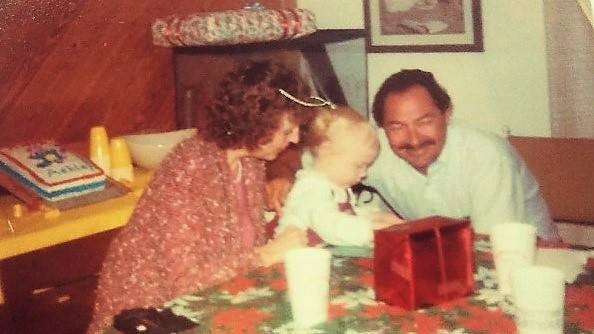
Ah, but you did, and he knew it . . . but darn that algebra. Hugs <3
At Mom's memorial service, I didn't cry. I had been with her almost every day of her long battle with cancer, and I knew how ready she was for it to end. I was afraid people would think I was unfeeling, but my Aunt Agnes came to my side and quietly said, "Did you ever notice that the people crying hardest are the ones who know they didn't do what they should have when they still could?"
Mom said at Dad's funeral that his work friend should have visited when he was alive and could enjoy it.