
J.C.

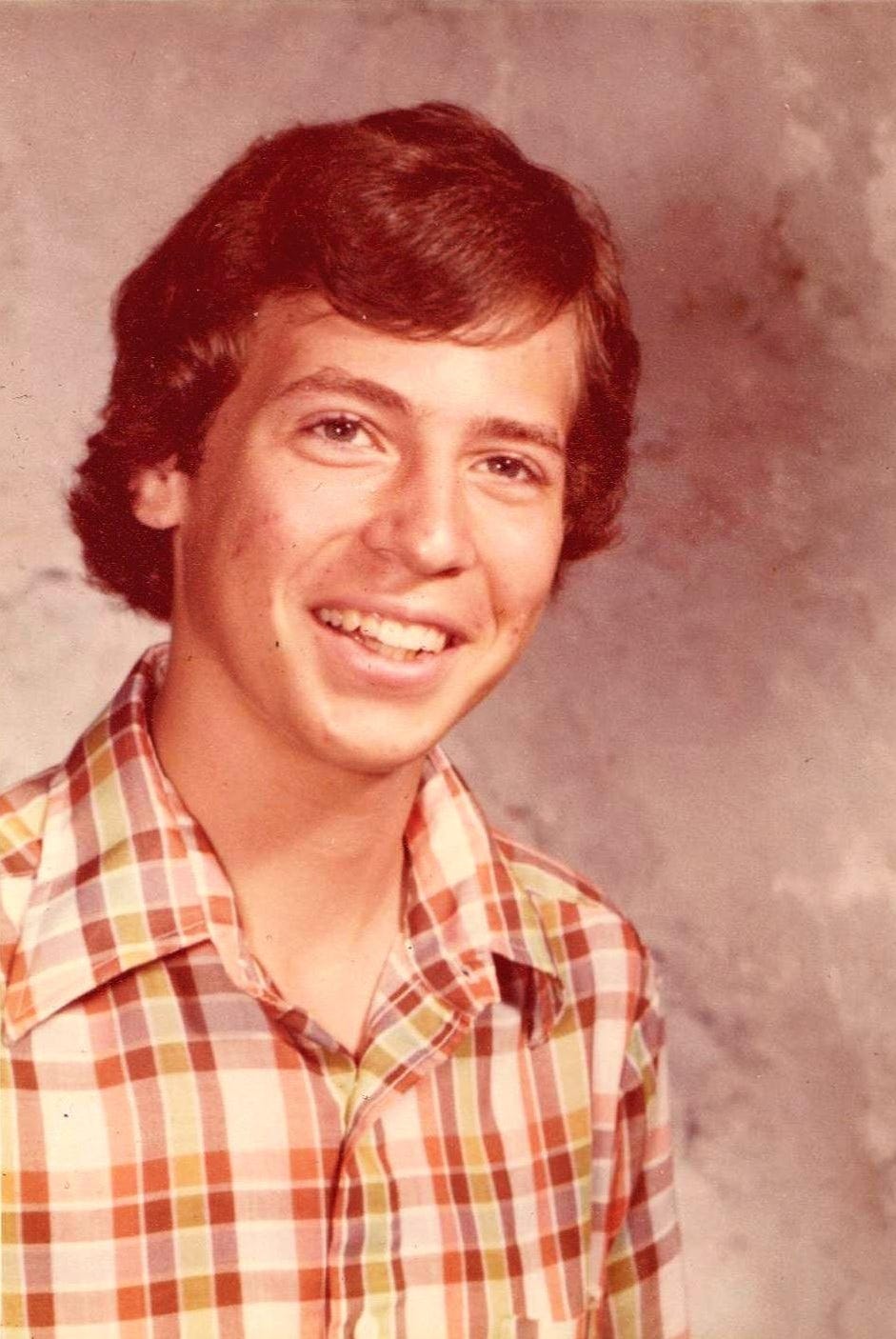
I went to high school out of district. While the friends I’d known since first grade went to Boyd Anderson High School, three blocks from our house, I went to Fort Lauderdale High School. Dad dropped me off on his way to work and I took the city bus home.
Fort Lauderdale High School was the oldest school in the city and was in the district where the wealthy kids went to school. We were firmly middle class.
I have always been introverted. I make friends slowly, and forever. The slowly part was hard on me at FLHS. My classmates had known each other for years. They chatted happily the first day of school while I sat at my desk, ignored, but not making any overtures to anyone, either.
English, Geometry, Biology, they were all the same. Thank God for Drama I. There were only 15 of us in the class, with a built-in common interest.
That first day Miss Ledford, all five foot five of her, took attendance. “Susan Lockmiller?”
“Here!”
“David Sokolov?”
“Here.”
“Robert Byrd?”
I was too shy to tell her I went by Bob. “Here!”
I expected classes filled with monologues, skits, improv, stage makeup and so on. Those first three weeks were murder. Lectures on Sophocles, Stanislavski, Strasberg; the different kinds of spotlight lenses (the only one I remember is Fresnel). Every day after answering to Robert, I took notes, studying them for the upcoming test, and regretting ever signing up for this class.
My classmates and I felt like we’d been ripped off. When we saw each other in the halls we groused and complained.
And bonded.
After the test, which I barely passed, the fun stuff I’d hoped for started. We learned how to mime, not just being trapped in a box, but walking in place that looks like walking down the street. We learned stage makeup. We were given practice scenes. “Robert, are you ready with your original mime?”
Because we’d all bonded over those torturous weeks, I had friends, not just people I went to class with. I was also more relaxed around Miss Ledford, but I never corrected her on my name. I’d been answering to Robert for over a month. I didn’t want to look like a jerk by only just now correcting her.
My other classes were still lonely, but people at least knew who I was now and one or two even spoke to me. Spanish class was fun, thanks to Bufano Boy and Gilbert Girl.*
Extracurricular activities were there for the picking, but none of the fruit appealed to me. Sports? Have we met? I thought about band, but didn’t believe I was good enough on the trombone that I played in middle school. There were clubs out the wazoo. I never did learn the difference between the Key Club and the Exchange Club. I also never understood how a high school full of kids of lawyers, doctors, and architects had such a large Future Farmers of America club.
You couldn’t join Thespians until you’d been invited, and you weren’t invited until you earned ten points. You’d get half a point each time you worked on sets. Two points for having a supporting role in a play. Four points if you were the lead, and so on.
Eight weeks into the semester and I had half a point after helping paint flats one Saturday. The same week I completed my first step to being a Thespian, the Key Club sold carnations. Everyone was excited. This FLHS tradition was new to me. Four or five times a year you could order a carnation from a Key Club member. You filled out the card to your sweetie, or whoever you were ordering it for. On flower day during 2nd period club members delivered the flowers to all the classes.
I had drama pals now but none that were worth two bucks. Even so, when a Key Kid stopped me between classes to ask if I’d buy a flower I parted with my lunch money. I filled out the card while he waited:
To Miss Ledford,
From Bob, not Robert-- Bob.
Bee, Oh, Bee, BOB
It took so long for the damn things to be delivered–weeks, not days–that I soon forgot about it, and continued answering to Robert. Everyone else in class called me Bob but Miss Ledford never noticed.
When the flowers were finally delivered during second period, I suddenly got nervous. Would she be mad? Think I’m weird?
She didn’t mention it when I walked into her classroom two hours later. She just nodded hello, convincing me my idea was a mistake. Once we were seated, she took attendance.
“Susan Lockmiller.”
“Here”
“David Sokolov.”
“Here.”
“Bob, not Robert, but Bob, bee oh bee Bob, Byrd.”
“Here!” I laughed, mirroring her grin.
I auditioned for the first school play of the year, Our Town. I was cast in a very minor role. I wasn’t disappointed, as I was still new enough that I was more comfortable in the background. Miss Ledford cast Renee Bufano, as the Stage Manager, which caused a few ripples I never understood. Even though there was nothing gender bending about it, having a female in the role was pearl clutching for some. Renee was Scott Bufano’s sister. I reached out to her after I learned that Scott had died of AIDS related complications. Years later she and I were talking about Scott and I reminded her that we first met in Our Town. “I have only fuzzy memories of that. I was high off my ass every night.”
I’d never guessed. I don’t know if it’s because I was naive, or because she hid it so well.
The role of Emily was played by Amy Spitzmiller, a sophomore. Her performance absolutely wrecked me in every rehearsal. In the funeral scene on opening night my tears were real, thanks to Amy.
Other roles were cast by seniors and juniors. It was obvious that some of them had been in several school plays. Those veterans called Miss Ledford, “J.C.” Miss Ledford’s first name was Julia. No one knew what the C stood for. She kept that a closely guarded secret. I was a freshman in my first play. No way in hell was I going to call her anything other than Miss Ledford. That changed by the next play, an original musical based on Shakespeare’s As You Like It.
We practiced every night. After Friday night rehearsals everyone went to Lums, a local restaurant. It was at those Friday night suppers that I felt like I was truly part of this magical group.
The cast party following plays were held at J.C.’s house, which was half a block from school. She had two dogs, Sam and Max that she doted on. Max took a liking to me, which annoyed some of the kids who’d known him much longer than I.
Two seniors, Bob Klaffky and Carol Collins, become great friends They took me to my first musical, A Chorus Line. We drove to Orlando to watch the touring company. I grew up on cast recordings of Rodgers and Hammerstein, Lerner and Lowe, Jerry Herman, and Irving Berlin. A Chorus Line was an eye opener. You’d never hear,”tits and ass” in a Hammerstein lyric.
After I’d become comfortable calling her J.C., I asked her why she called me Robert for weeks when she knew everyone else called me Bob.
“Bob Klaffky auditions for every play. On the first day of school I knew you’d be as involved in drama class as he is. Two Bobs in the same plays could be confusing when I’m yelling at one of you; one Robert and one Bob would be easier to fuss at.”
After the first Key Club flower sale, I made it a point to buy a carnation for J.C. and for my friend Mary, aka Gilbert Girl, every time they were sold by different service clubs.
Toward the end of the year J.C. asked me to play Haemon in Sophocles’ Antigone. The FLHS Drama club was entered in a statewide competition. If you aren’t familiar with the play, here’s a quick summary:
After a civil war in Thebes, Antigone’s two brothers kill each other. One brother defended the city; the other attacked it. The new king, Creon, declares: the “good” brother gets an honorable burial and the “traitor” brother’s body will rot unburied outside the city walls.
Antigone says, “Screw that,” and secretly buries her brother anyway. Creon catches her and decides to punish her publicly. Just one problem: she is engaged to Creon’s son, Haemon, played by me. Blah blah blah, Greek Tragedy, yadda yadda yadda, Creon finally says fine, Antigone won’t be punished but by then, she has hanged herself. I’m so mad I try to kill Creon but I suck at fighting so I kill myself instead. My mother, Creon’s wife, hears I’m dead and SHE kills herself.
“What kind of play is this?” I asked. “I’m dead, my mother’s dead, my girlfriend’s dead–the only one alive is Creon and he’s been spiritually destroyed. Are we passing out the suicide hotline to the audience after this laugh-fest?”
“That’s why it’s called a tragedy, Bob. Not every story has a happy ending. But they still need to be told.”
Creon was played by a senior named Rollin Jewett. His face was all long lines and shadows–straight nose, sharp jaw, heavy lashes, all framed by wavy black hair. So not only was my “dad” responsible for the death of my girlfriend, he was responsible for me needing a cold shower before, during, and after every rehearsal.
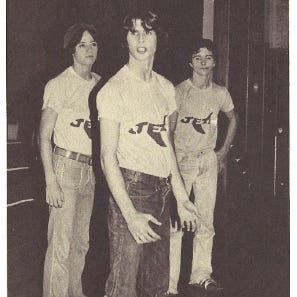
During rehearsals J.C. took notes and after each run through sat us down to critique our performances. I accepted her suggestions with an attitude of “I have no idea what I’m doing in this doom-fest so I’ll do whatever you say.” Rollin was different. He took the mildest criticism or suggestion as confirmation of failure. He looked so downcast that my heart went out for him, even though J.C. wasn’t being even a little unkind.
After rehearsal one night Rollin and the other cast members drove home. I was fourteen and had to wait for Dad to come get me. Rather than leave me alone at school, J.C. waited with me.
“Rollin is really good,” I said.
“Yes, he is,” J.C. agreed. The look she gave me told me I might have been a little too effusive in my praise and I toned it down.
“I wish he wouldn’t get so sad when you review our scenes,” I said, avoiding her eyes.
“So do I,” she said. After a minute she said, “Some people are so good at pretending they are something they’re not when they’re on stage, because they’re so good at doing it twenty-four, seven. They’re scared that if people see through the pretense they’ll be rejected.”
I tried not to show my panic. Was she talking about Rollin, or me? She went on. “The sad thing is, they’ll never know they’re good enough when they’re not pretending.”
Dad pulled up to the stage door. “I gotta go!” I shouted, running to the closeted safety of his Impala.
The next year I learned that Drama 2, 3, and 4 all took place at the same time. In addition to the two drama classes, and the Debate class, J.C. taught two English classes, but everyone knew where her heart was.
I don’t think anyone in the advanced Drama class called her Miss Ledford. In addition to acting out scenes by established playwrights we were encouraged to write our own scenes and perform them.
We had to select a play and design a set for it. I chose The Crucible. I’d read it the year before in English and it stuck with me. My design was hackneyed and juvenile–what was a cross on the mantle in Act 1 morphs into a hangman’s noose in Act II, that kind of thing. J.C. was kind in the notes she wrote in the margins when she handed it back to me. The one I still remember is, “subtle can be stronger than In Your Face.”
Midway through my sophomore year, Sister, Joe and I were watching TV in the Family Room. Around nine o’clock, Mom and Dad came out of their bedroom. Mom looked grim. Dad was crying. This was before the family dog died and I’d never seen him cry before. He hugged Sister, me, and Joe while Mom explained that they were going to the Emergency Room.
Seven years earlier, Dad came home from work with bad heartburn, which quickly evolved into painful pressure. Both my parents dismissed the idea of a heart attack; he was only thirty-three years old. After several hours a family friend who was a nurse convinced them to go to the hospital. The cardiologist told them that if they’d waited any longer he’d probably have died of the massive coronary.
With this second heart attack he knew exactly what it was. They wasted no time in getting to the hospital (Dad had two more heart attacks but the only time an ambulance was involved was after he’d died). Dad didn’t expect to come home again. I can’t speak for Sister or Joe, but I was too afraid to cry.
Mom promised she’d call as soon as she knew something, put Sister in charge and they left.
They weren’t out the door more than five minutes when Sister called Kenny. He was her boss at Kinney Shoes. I haven’t changed any names, not Amy’s or J.C.’s or Kenny from Kinny’s. Sister had been working at Kinney’s for a couple of months. We were all sick to death of hearing about how great Kenny was. I didn’t know precisely what they were to each other but we all knew it went beyond Boss and Employee. Hanging out after work, the occasional dinner or going to the movies at the mall cinema when the shoe store closed. Sister was seventeen. Kenny was Mom’s age.
I retreated to my bedroom but when Kenny arrived, Sister insisted I join them in the family room so he could comfort all of us together. I suppose that was better than him comforting just Sister in her bedroom, but not by much.
I waved hello as I passed them on my way to the wall phone. The cord was long enough that I could take it into the garage for some privacy.
I didn’t have to look up J.C.’s phone number. I’d had it since Our Town in case I needed to call out sick for practice or something. Likewise, she didn’t have to look up my address. She’d taken me home from rehearsal before and had picked me up on Saturdays for set construction.
It was pretty late, and a school night to boot. It took a few rings before she answered.
“J.C.?” My voice quavered.
“What’s wrong, Bob?”
“My dad’s dying and I’m stuck in the house with a pervert.”
I filled in the blanks but before I could ask her to rescue me she said, “I’ll be there in half an hour.”
Sister wasn’t happy when I told her I’d called J.C. “Mom put me in charge, and I’m not letting you go.”
Kenny said, “Glenda’s right, my man. You should stay here.”
If I hadn’t been so tense I would have kept quiet. “Sister may be your woman, but I am by no means your man. You’re her boss, not mine, so your vote doesn’t count.”
None of us was willing to continue the fight. Why hadn’t Mom called, yet? Joe, Sister, and Kenny sat on the couch. I was perched on a barstool at the kitchen island. Kenny patted Sister’s hand. I glared at him, Sister glared at me, and Joe just sat there looking scared.
When the doorbell rang Kenny leapt up. “I’ll get it!”
I was on his heels. “It’s not your house! I’ll get it!”
None of us got it. J.C. opened the door and stepped inside. She ignored Kenny and looked at me. “Are you ready?”
“Yes!” I said.
“No!” Kenny and Sister, who had joined us in entryway said together.
Kenny said, “I don’t think Bob’s parents would approve of an adult, twice his age, taking charge of him when they aren’t here.”
J.C. smiled and held out her hand. “Hello, I’m Ms. Kettle. You must be Mr. Pot.” She turned to me and repeated, “Are you ready?”
I followed her outside. We drove around while I told her about Dad’s first heart attack. We ended up at the Clock Diner. Lums had been closed for a couple of hours by then. The Clock, open twenty-four hours, was our backup.
She’d already gone from Miss Ledford to Miss Kettle. By the end of the evening she was practically Miss Van Gogh—I talked her ear off. Middle school, slash Puberty had been rough. Dad and I fought constantly. I was convinced he hated me. In hindsight I’m sure he was convinced I hated him. J.C. assured me we were both wrong.
When Mom and Dad left the house earlier I’d been too stunned to say anything, including, “I love you,” which I’d recently learned to include with every goodbye.* Between that, my fear, and the vivid memory of our prior screaming matches, I was in bad shape.
“What hospital did your dad go to?”
“I don’t know.” Dad had been at Holy Cross when he’d had his first heart attack. The nurses were all nuns and they wore the uniform of their spiritual profession, not their medical one. They gave Dad the willies. He said he couldn’t tell one penguin from another which made it hard to keep up with which ones were mean old bitches. “I don’t think it’s Holy Cross, though. Maybe Imperial Point?”
J.C. looked at her watch. “I expect you’ll stay home tomorrow, but I’ve got to get up for school. Are you okay to go home? I’ve done all nighters before so if you’re not . . .”
“No, I’m okay,” I lied. Putting words to my feelings had left me drained.
J.C. paid for our coffees and took me home, but not before making a detour to Imperial Point Hospital. I’d guessed correctly. Dad had been admitted to ICU. It was close to midnight now and the lights outside the double doors leading to ICU were dim.
I pointed to a sign on the doors that listed visiting hours, which ended about the time we pulled into the Clock parking lot. The sign also said that visitors must be eighteen or older. Even if we didn’t arrive three hours too late, I was still three years too early.
“Wait here,” J.C. whispered and disappeared behind the swinging double doors.
When she came back a couple of minutes later, a nurse was with her. “Five minutes,” the nurse told me. I followed her to Dad’s curtained off area. He was awake, and much calmer than when I last saw him. At the time I thought that meant he no longer had anything to be afraid of. Now I suspect it was the morphine drip.
When he saw me he broke into a smile. “Bob!” I ran to his bed but was afraid to hug him, lest I dislodge one of the wires on his chest or IV tubes in his arm and neck. “You just missed your mother.” He pointed to the nurse who’d bent the rules to let me see him. “No penguins. I can keep track of who’s mean and who’s not. That one’s mean.” He winked at her. With that Dad Joke and wink my own fears melted away.
He asked how I’d gotten there and I briefly told him about my night. He looked behind me. “Where’s your teacher?”
“Waiting for me in the hallway.” The nurse cleared her throat. “I have to go. I love you, Dad.”
“I love you too, son. Listen, tell Miss Ledford I said thank you and tell Kenny I have a gun.”
“You don’t have a gun.”
“Kenny doesn’t need to know that.”
Soon after Dad’s heart attack J.C. called me to her desk. “I want you to compete in the NFL.”
“Okay, as soon as I pitch a no-hitter at the World Series.”
“The National Forensics League,” she said. I mentioned earlier that she taught Debate. Our team brought home a lot of trophies.
My idea of a well reasoned counterpoint was, “bite me.” I raised my eyebrows and asked, “Debate?”
“Lord, no. You’d be disqualified as soon as you opened your mouth. I want you to compete in the Oral Interpretation and the Extemporaneous competitions.”
Oral Interp involved performing someone else’s material; Extemp required giving a short speech on a randomly assigned topic. To my surprise, I did pretty well at both.
I continued with the Extemp and Oral Interp contests the rest of the year, winning as many as I lost.
I had by no means abandoned drama. I auditioned for every school play, getting some meaty roles in a Thurber Carnival, stage managing Spoon River Anthology, the lead in The Taming of the Shrew, and my crowning achievement, the lead in the third act of Plaza Suite.
My friend Dan, whom I’d later go to London with, had recently transferred to FLHS. One day in class J.C. told us about him. I can’t remember where he’d come from but she was very concerned that he would be joining the class midyear. “You’ve already formed some solid friendship groups. I don’t want him to feel excluded. Some of you can be pretty catty, which is an asset on the Tonight Show, but not in my class.” Dan’s parents had just divorced. His Dad lived in England with his former mistress, now his pregnant wife. His Mom lived nearby with her “friend.”
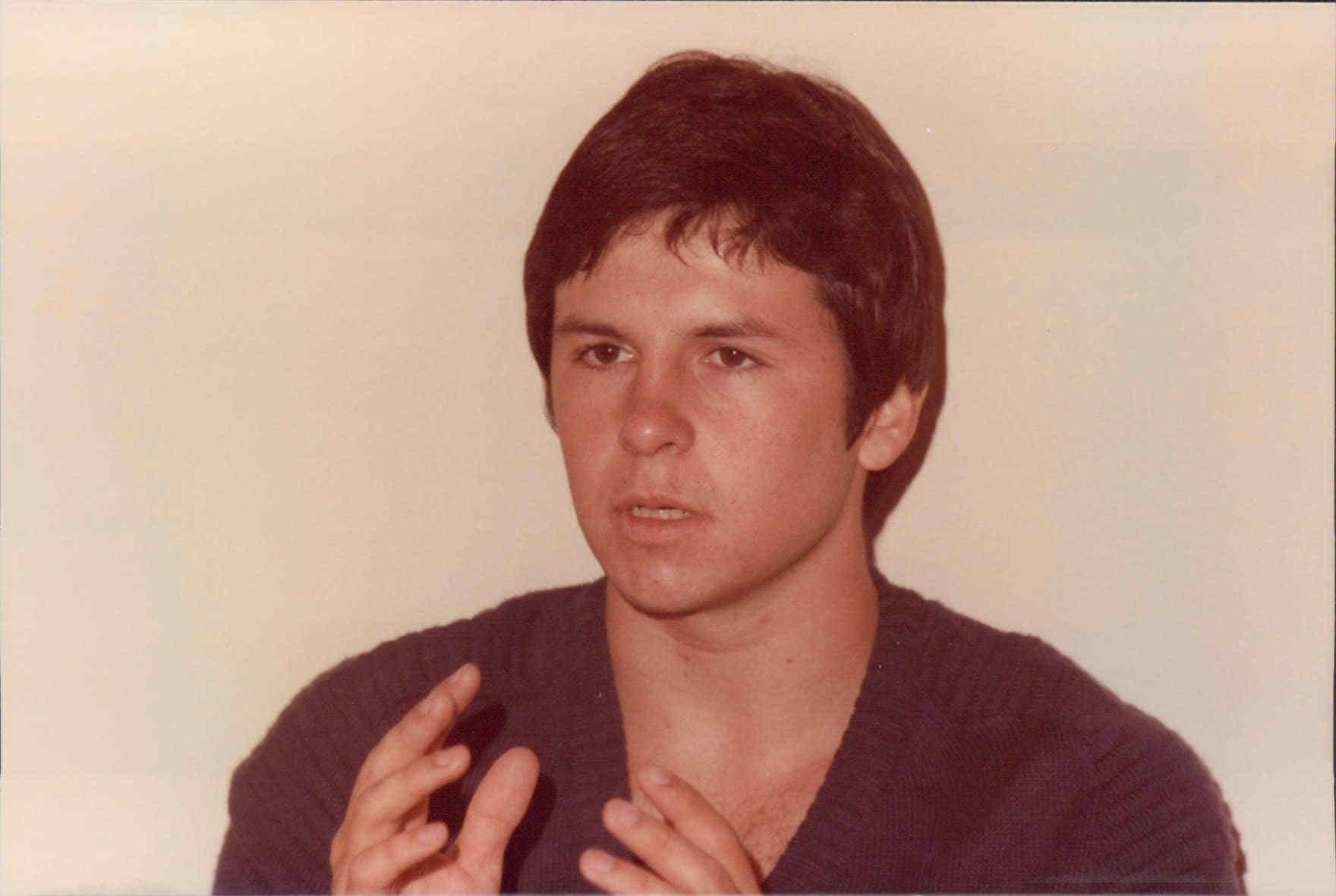
J.C. worried needlessly. We took to Dan immediately. He still acts today. I often see him guest starring on shows like FBI and Law and Order. I was channel surfing once and came upon him just as a bad guy shot him in the forehead. Seeing that, with no context, was disconcerting.
Dan got to FLHS in time for the last play of the year. I’d never heard of “David and Lisa” and knew nothing about it. Except for my walk-on in Our Town, I’d only acted in comedies. (I was behind the scenes for Spoon River Anthology.)
David and Lisa follows two emotionally troubled teenagers in a residential psychiatric treatment center. David is brilliant but terrified of physical contact, believing touch can kill him. Lisa suffers from a severe psychological disorder that leaves her speaking in rhymes and shifting between two personalities. As they slowly form a friendship, each begins to break through the barriers that isolate them from the world.
Dan was cast as David. My friend Debbie played Lisa. I was cast as the chief of psychiatry, Dr. Swinford, with whom David has several scenes. The last scene of the play is pretty intense. David and Dr. Swinford arrive at a park barely in time to save Lisa from being raped.
Debbie was very pretty, and had a waif-like demeanor. The role of Lisa was made for her, or she for it. It was impossible to watch her scenes and not feel protective of her. Her setbacks were heartbreaking to watch. When she was attacked by the would be rapists everyone–on stage, backstage, or sitting in the audience held their breath.
When David and Dr. Swinford run in from offstage in the nick of time, all those held breaths were released in a collective whoosh that was part sigh, part Whew, part sob.
A week before opening night J.C. had us run this scene over and over. The physical altercation between Lisa and her attackers, and the reactions of Swinford and David, had to be exactly right. One wrong move could ruin the climax the play had been building toward. J.C. said, “You can make the audience believe anything, if you believe it yourself.”
We started the scene for the twentieth time. Usually Dan and I waited together in the wings until our entrance but this time Dan said he’d be right back and ran off to the costume room. When he returned he held two pink taffeta tutus. He handed me one and put on the other one. “This scene is too heavy. We need to lighten things up.”
I was torn. I wanted to get this right but I also had a minor crush on Dan. Even now he’s crushworthy. J.C. did say to make him feel welcome...I stepped into my tutu.

The faux rapists and Debbie were scarily believable. This was my umpteenth time in a row seeing it but this performance was raw. My heart sped up. On cue, Dan and I ran out on stage. We’d taken three steps when J.C. shouted, “Stop!”
Debbie and the ruffians were confused until they saw where J.C.’s ire was aimed. This was supposed to be a joke but no one was laughing. By now J.C. was at the foot of the stage. I’d never seen her so angry.
“What the hell is wrong with you?” She moved her glare from me to Dan. “Both of you?”
I stared at my feet.
“Sorry,” we mumbled.
“I don’t know what pisses me off more: that you think sexual assault is something to joke about, or that you think mental illness is laughable–” she aimed the glare squarely at me. “Or that you’re so afraid of being serious for half a minute, in case people might see what’s under all the jokes.”
I remember how miserable Rollin looked when she talked about where his performance needed work. This was different. It wasn’t about the work. Rollin had been ashamed of his acting; I was ashamed of myself.
J.C. canceled the rest of the rehearsal and sent us home to give us time to think about how committed to the play we were. Dad wasn’t due to pick me up for another hour. Debbie drove me home, but I wish she hadn’t. She had gone to places she’d never been to nail that scene and I made a mockery of it. I couldn’t blame her for being disappointed in me.
The next night we once again tackled the rape scene. After our fifth or sixth time J.C. exhaled loudly. “You believe it.” I knew she did, too.
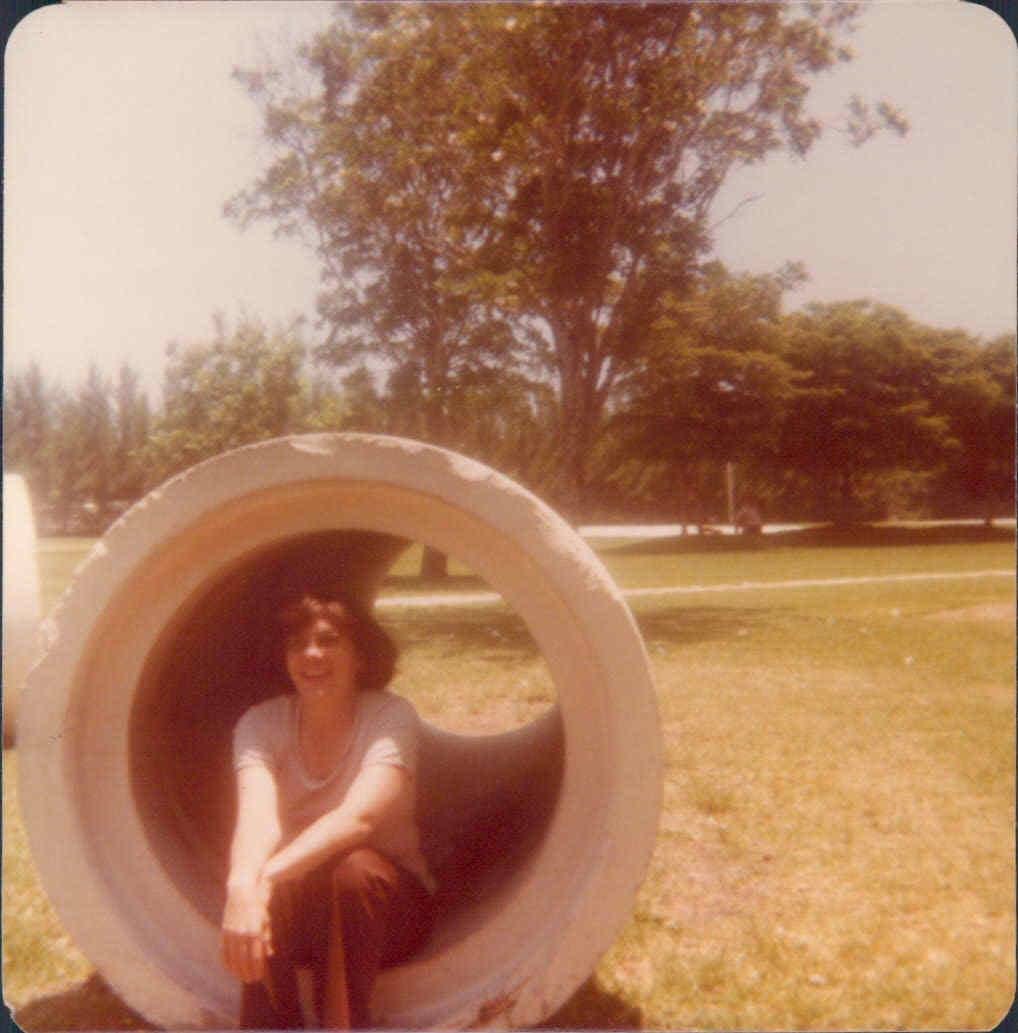
We had the cast party at Holiday Park instead of J.C.’s house. I took my one and only photo of her that day. We played Improv games, but no oral interp. J.C. brought the burgers and charcoal. The rest of us chipped in buns and coleslaw and Cokes.
The next Monday after she took roll J.C. said, “I have some news. I’m moving back to Kentucky at the end of the school year.”
There were gasps and “No!”s and “Why?”s
She gave several reasons. Her family was there and not getting any younger. She looked a little wistful and said, “I left my boyfriend and my hopes of getting a PhD behind when I came here.”
Dan said, “You can get a PhD in Miami.”
Someone else said she could get a boyfriend in Miami, too.
“Bob, you’re usually the first one to speak up. Do you have any questions?”
“Please don’t go,” I said.
The day after classes let out some of us went to her house to help her pack. Bob Klaffky was in college now but he came to help, too. Soon after he showed up, she said, “Bob, will you help Bob-not-Robert-but-Bob-B-O-B-Bob bring the boxes from the attic?”
“Uh, sure?” Bob K was konfused.
Bob was well over six feet tall. It was easier for me to climb into the attic and pass boxes to him as he stood on the folding stairway. Then I climbed down and we carted boxes to the living room where J.C. supervised what went where: Pack, Toss, Donate.
In addition to the two boxes of books I carried, I balanced an old hatbox on top of them. I couldn’t see J.C. wearing a hat, unless it was a saucy French beret. Curiosity got the better of me and I opened the box. Inside was an old felt fedora with a cleaning ticket dated 1941. Did people have to get their hats cleaned?
J.C. saw it and got that faraway look in her eyes. “That was my Grandfather’s Sunday hat.”
“It’s beautiful!” I said.
“Do you want it? It’s yours.”
I asked her a dozen times if she was sure before accepting it. I wore it several times, always looking like an oddball or relic, until it was destroyed in the house fire.
There were still boxes in the attic so Bob and I went back for another haul. When I picked up the last box the bottom gave out. Dozens of letters, forms, legal papers, deeds, titles, and who knows what all, slid across the floor of the dusty attic. As I collected them I couldn’t help noticing the name printed on some of them.
Julia C____ Ledford, only the middle name was spelled out. It must be a family name of some kind. I’d never heard the name before or since, and you aren’t going to hear it from me now. I jerry-rigged the box so I could refill it with the paperwork, then toted it downstairs.
“The box broke. I think I got everything though. I thought you might want to seal this one up. I picked up an envelope with her full name on it. She saw it and raised an eyebrow. “I won’t tell,” I said. And I never have.
The next year Mrs. Jameson taught drama. She was a lovely lady, but she was an English teacher who’d been tasked with teaching drama. J.C. was a drama and debate teacher who’d been tasked with teaching English.
There were no more lectures about set building or spotlights. No more comparisons between the Stanislavski method and the Strasberg method of acting. No more school plays. Lots of charades and acting out scenes with each other in class. When I was forced to choose between Drama and English 3AP, both of which were offered only during 5th period, I chose English. I would have had a hard time choosing if J.C. had still been here.
The old gang was as tight as ever. We got together often. Pool parties at Dwight’s house in the ritzy part of town, and themed parties at my house–Halloween, Broadway, an election-themed party. At one of the parties I hosted I sprung a surprise on everyone. I’d called information and got J.C.’s new phone number in Kentucky. We called her and took turns chatting. It was good to hear her voice but she didn’t seem as excited about the call as we were. I got the feeling we’d interrupted something.
We tried calling her again a couple of months later at another party, but there was no answer. Voicemail hadn’t yet come around and not everyone had an answering machine. The next time we tried we got a recording saying the number had been disconnected. Had she moved again? Or was she closing the door on Fort Lauderdale? I missed life with J.C. but eventually we got used to life without her.
Jump ahead a few decades. The internet is a part of life now, which makes it easier to track down people with whom you’ve lost touch. A search of J.C. Ledford didn’t return any helpful results. I tried again using Julia Ledford and there was a notice of her retirement from Owensboro Community College. The piece referred to Doc Ledford, or just plain Doc. I was pleased she got her PhD.
There were glowing comments from faculty and students about Doc. I admit I was a little resentful that “Doc” had replaced “J.C.”
Since she’d retired, there was no longer a school email address for her. I emailed the Dean of the Drama department instead. I told him that Doc had been my drama teacher in 1978 and 1979, and how much she influenced my life. I said that I knew he couldn’t give me her contact info, but asked if he’d pass along my phone number and email address to her, and ask her to get in touch.
He wrote back, saying I was one of a thousand people Doc had touched and he’d be happy to forward my email to her.
That was a couple years ago and I’ve yet to hear from her. I am confused and sad. Had I offended her without knowing it? I had my arrogant, asshole-ish moments in high school; had one of those outbursts put me on the outs with her?
My first year of high school she was an oasis in a desert of loneliness. She made me feel seen, without making me feel like I was under a spotlight, Fresnel or otherwise. I’m pretty sure she saw beneath my heterosexual facade. She never asked me about it, but it was clear that if and when I was ready to bring it up, she’d be a safe audience.
I don’t know what I would have done if she hadn’t been there when Dad had his heart attack.
Why hadn’t she reached out? If I knew, I could try to make amends. She is the last person in the world I’d want to hurt or anger.
I haven’t reached out to the university again. I have no reason to doubt my message had been delivered. I’ve learned to accept that she’d prefer to be Doc and not J.C.
Not every story has a happy ending, but those stories still need to be told.
EDIT: a friend in Oregon forwarded this to his friend in Ohio—Bob Klaffky. I’ve been chatting with Bob and he told me that J.C. passed away 3 years ago.
*


Glad you wrote this. Life can be so hard and also so wonderful.
What a tale! I'm sure you did nothing she would find unforgivable, or even needing forgiveness. Teachers know how hard the teen years are. Perhaps this story will make a connection. <3
I wish I could time-travel to see you in TAMING.